Back to Uncategorized
Sale!

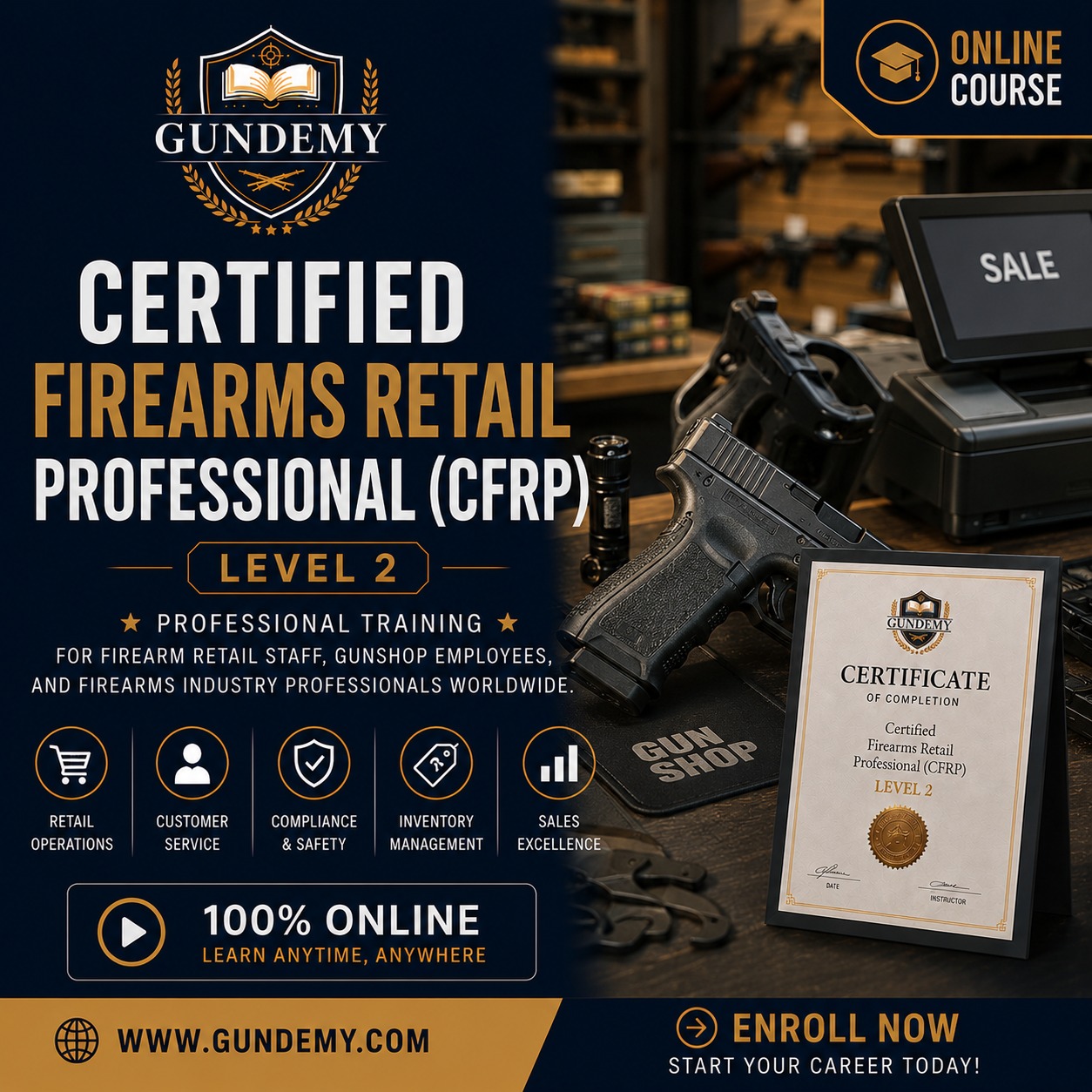
Certified Firearms Retail Professional (CFRP) – LEVEL 2

Original price was: R1 614,29.Current price is: R807,14.

Certified Firearms Retail Professional (CFRP) is a career-focused online certification designed for individuals who want to work in the firearm retail industry or improve their performance in a gunshop environment.

This practical, skills-based course provides structured training in firearm product knowledge, ammunition selection, optics, accessories, and professional customer advisory techniques used in real retail settings.

Learners gain the ability to confidently guide customers in choosing firearms, calibers, and equipment while applying responsible sales practices, ethical decision-making, and safe handling awareness.

The course also covers gunshop operations, customer behaviour, inventory basics, and compliance awareness, making it ideal for both new entrants and existing retail staff seeking professional development.

Ideal for: aspiring gunshop employees, firearm retail staff, sales assistants, and anyone preparing for a career in the global firearms industry.

Certification: Level 2 – Certified Firearms Retail Professional (CFRP)

Description

Certified Firearms Retail Professional (CFRP)

Certified Firearms Retail Professional (CFRP) is a career-focused firearms retail course designed for individuals who want to work in the firearms industry or develop professionally within a gun shop or retail environment.

This is a skills-based certification focused on real-world retail performance, helping learners build capability in sales, advisory, and product knowledge.

Course Duration

12–15 hours

Who This Firearms Retail Course Is For

Individuals who want to enter the firearms retail industry.

Job seekers preparing for gun shop or firearm-related roles.

Retail staff who want to improve product knowledge and professionalism.

Anyone looking for a retail job-relevant certification in the firearms sector.

Learners progressing from foundational firearm knowledge training.

What You Will Learn

How to guide customers in choosing firearms, calibers, and ammunition.

How to compare firearm options based on purpose, fit, and budget.

How to recommend optics and accessories correctly in a retail environment.

How to explain firearm pricing, value, and product differences clearly.

How to handle customer questions with professional structure and confidence.

How to apply safe handling and responsible retail practices.

Career Outcomes

This firearms retail course prepares learners for real opportunities to work in the firearms industry, including gun shop roles and customer advisory positions.

Progression

Level 3 – Certified Firearms Sales Specialist (CFSS)

Level 4 – Certified Firearms Industry Professional (CFIP)

Level 5 – Master Firearms Industry Professional (MFIP)

Final Assessment and Certification

Module quizzes, final exam, scenario-based questions, and digital certificate with verification ID.

Lifetime Access Included

Complete the course once and return whenever you need a refresher. All students receive lifetime access to their online course content, making it a valuable long-term reference resource.

Disclaimer:

The Certified Firearms Retail Professional (CFRP) course is an independent private training program developed by Gundemy. It is intended for educational and professional development purposes only and is not a substitute for official licensing, legal certification, or regulatory approval in any country or jurisdiction.

Firearm laws, licensing requirements, storage rules, and sales procedures vary by location. Learners are responsible for understanding and complying with all applicable laws, regulations, and requirements in their own jurisdiction.

This course provides general industry knowledge, retail guidance, and practical frameworks based on widely accepted firearms retail principles. It does not provide legal advice, compliance certification, or authorization to sell, handle, possess, purchase, carry, or use firearms.

All firearm handling, storage, sales, and use must be conducted safely, responsibly, and in accordance with local laws and established safety standards. Gundemy, its instructors, and affiliates accept no responsibility for misuse, misinterpretation, or unlawful application of the information provided.

By enrolling in this course, the learner acknowledges that this is a knowledge-based training program intended to support professional development in firearms retail, and not a replacement for formal licensing, supervised training, or legally required certification processes.

Course Overview

Course Overview
Certified Firearms Retail Professional (CFRP)

Certified Firearms Retail Professional (CFRP) is a career-focused firearms retail course designed for individuals who want to work in the firearm industry or develop professionally within a gun shop, outdoor retail, or firearms sales environment.

This Level 2 certification helps learners build the practical retail knowledge used in customer-facing firearm industry roles. It focuses on real-world sales support, customer advisory, product knowledge, responsible retail communication, and confidence when discussing firearms, calibers, ammunition, optics, and accessories with customers.

By completing this course, learners can prepare for career opportunities such as firearms retail assistant, gun shop staff member, outdoor retail advisor, firearms sales support, customer advisory assistant, shooting sports retail support, hunting equipment retail advisor, or entry-level firearm industry professional.

The course is especially useful for job seekers who want a retail job-relevant certification, current retail staff who want to improve their professionalism, and learners progressing from foundational firearm knowledge into more career-focused firearms industry training.

Course Duration

12–15 hours

Certification Level

Level 2 – Certified Firearms Retail Professional (CFRP)

What You Will Learn

What You Will Learn

This course is designed to help learners build practical, career-ready skills for customer-facing roles in the firearms retail industry.

Learners will develop the ability to guide customers in choosing firearms based on purpose, fit, budget, and practical use.

Learners will understand how to explain caliber options clearly, including cost, availability, performance considerations, and long-term ownership needs.

Learners will learn how to recommend ammunition types based on customer use, budget, and expectations.

Learners will build confidence in comparing firearm options professionally without relying on brand bias, oversimplified claims, or personal preference.

Learners will understand how to recommend optics and accessories that improve usability, safety, and ownership practicality.

Learners will learn how to explain firearm pricing, value differences, and product positioning in a clear and professional way.

Learners will develop structured responses for common gun shop customer questions and learn how to communicate with confidence in retail conversations.

Learners will understand how to assess customer needs and match products to real-world use rather than assumptions.

Learners will learn how to apply safe handling principles and responsible retail practices in daily operations.

Learners will build confidence in firearm sales, advisory conversations, product guidance, and professional customer interaction.

Learners will gain an understanding of retail workflows, stock handling, and structured sales processes used in firearm retail environments.

By completing this course, learners will develop career-ready skills for roles such as firearms retail assistant, gun shop staff member, firearms sales support, customer advisor, outdoor retail advisor, and entry-level firearm industry professional.

Course Structure

Module 1: Firearms Retail Industry Overview

1.1 Types Of Firearm Retailers: Independent gunshops, retail chains, range-based retailers, gunsmith-attached shops, and online firearm retailers.

1.2 Gunshop Business Models: Firearm sales, ammunition margins, optics and accessory sales, training services, and seasonal cycles.

1.3 Retail Vs Range Vs Gunsmith Shops: Operational differences and customer expectations.

1.4 Customer Demographics: First-time buyers, hunters, sport shooters, collectors, and occasional firearm owners.

1.5 Ethical Responsibilities: Professional conduct when selling regulated products.

Module 2: Firearms Product Knowledge (Retail Level)

2.1 Introduction To Firearm Categories: Handguns, rifles, and shotguns.

2.2 Handguns Overview: Semi-automatic pistols vs revolvers, magazine capacity concepts, concealability, and typical uses.

2.3 Rifle Platforms: Bolt-action, lever-action, semi-automatic where legal, and single-shot rifles.

2.4 Shotgun Platforms: Pump-action, semi-automatic, break-action, over-under and side-by-side shotguns.

2.5 Firearm Action Types: Bolt, lever, pump, break, and semi-automatic actions explained.

2.6 Caliber Vs Cartridge: Understanding the difference between caliber terminology and a full cartridge.

2.7 Rimfire Vs Centerfire: Differences in ignition systems and typical uses.

2.8 Comparing Common Calibers (Retail Level):

2.8.1 Common Handgun Calibers: .22 LR, 9×19 mm (9mmP), .40 S&W, .45 ACP.

2.8.2 Magnum Handgun Calibers: .357 Magnum, .44 Magnum, .454 Casull, .500 S&W.

2.8.3 Common Rifle Calibers: .22 LR, .223/5.56, .243, .308, .30-06.

2.8.4 Large And Magnum Rifle Calibers: 7mm Rem Mag, .300 Win Mag, .338 Lapua, .375 H&H, .416 Rigby.

2.8.5 Shotgun Gauges: 12 Gauge, 20 Gauge, .410 Bore.

2.9 Firearm Comparison Framework For Retail Staff:

2.9.1 Comparing firearms by intended use.

2.9.2 Comparing recoil and shooter comfort.

2.9.3 Comparing ammunition availability.

2.9.4 Comparing reliability and durability.

2.9.5 Explaining price differences between firearms.

Module 3: Ammunition Knowledge And Retail Applications

3.1 Rifle Ammunition Types: FMJ, soft point, polymer tip, match ammunition.

3.2 Handgun Ammunition Types: FMJ training ammunition and defensive hollow points.

3.3 Shotgun Ammunition Types: Birdshot, buckshot, and slugs.

3.4 When To Sell Which Ammunition: Matching ammunition to training, hunting, or sport shooting.

3.5 Bullet Weight Concepts: Understanding grain weight.

3.6 Ammunition Packaging And Storage: Retail storage considerations.

3.7 Ammunition Brand Differences: Entry-level vs premium ammunition brands.

Module 4: Ammunition Components And Reloading Equipment

4.1 Ammunition Components: Brass case, primer, powder, and projectile.

4.2 What Reloading Is: Concept of reloading cartridge cases.

4.3 Reloading Equipment Categories: Presses, dies, powder measures, priming tools.

4.4 Reloading Products Sold In Gunshops: Starter kits, presses, dies, consumables, manuals, and safety equipment.

4.5 Retail Conversations About Reloading: Setting expectations, advising safely, and knowing when to refer customers to training.

4.6 Precision Measuring Tools: Calipers, powder scales, case gauges.

Module 5: Optics And Mounting Compatibility

5.1 Types Of Optics: Red dots, holographic sights, and rifle scopes.

5.2 Optics Price Tiers: Entry, mid-range, premium and what improves at each level.

5.3 Scope Rings And Mounting Systems: Ring sizes, heights, tube diameter, and fitment basics.

5.4 Picatinny Vs Weaver Rails: Compatibility concepts and customer guidance.

5.5 Matching Optics To Intended Use: Hunting vs target vs defensive and practical recommendations.

5.6 Understanding Optic Specifications: Magnification ranges, reticles, objective lenses, and parallax basics.

Module 6: Firearm Brands, Quality Tiers And Product Positioning

6.1 Budget Firearms: What to expect and how to explain trade-offs professionally.

6.2 Mid-Range Firearms: Reliability, finish, triggers, accuracy expectations, and value discussion.

6.3 Premium Firearms: Precision, materials, support, resale value, and customer profiles.

6.4 Handgun Brand Positioning: Comparing common brands by price tier and use-case.

6.5 Rifle Brand Positioning: Comparing common brands by intended application.

6.6 Optics Brand Comparison: Budget vs premium optics and what changes.

6.7 Explaining Brand Differences Professionally: Facts, pros and cons, and avoiding bias.

6.8 Helping Customers Choose Between Brands: A structured comparison method for retail counters.

Module 7: Firearm Fit And Ergonomics

7.1 Handgun Fit: Grip size, trigger reach, controls, recoil perception, and comfort.

7.2 Rifle Fit: Length of pull, cheek weld, eye relief, and scope height basics.

7.3 Shotgun Fit: Mounting feel, length of pull, and simple fit checks for customers.

7.4 Helping Customers Handle Firearms Comfortably: Safe handling guidance and in-store fit checks.

Module 8: Firearm Maintenance And Cleaning Products

8.1 Cleaning Equipment: Rods, borescopes, brushes, jags, patches, and pull-through systems.

8.2 Solvents And Lubricants: Cleaning vs lubrication vs protection and correct use-cases.

8.3 Maintenance Product Recommendations: Matching products to platform type and customer habits.

Module 9: Firearm Storage And Safety Products

9.1 Gun Safes: Basic types, capacity, locking mechanisms, and placement considerations.

9.2 Gun Cabinets: Practical storage and customer use-cases.

9.3 Lock Boxes: Handgun storage options and transport-friendly solutions.

9.4 Safe Storage Advice For Customers: Basic principles and responsible ownership reminders.

Module 10: Global Legal And Compliance Fundamentals

10.1 Why Firearm Sales Are Regulated: Overview of regulated product responsibilities.

10.2 Customer Eligibility Concepts: General eligibility principles and why shops must be cautious.

10.3 Background Check Awareness: Understanding that processes vary by country and retailer obligations differ.

10.4 Red Flag Sales Situations: Identifying warning signs and responding professionally.

10.5 Straw Purchase Awareness: Recognising suspicious purchasing patterns.

10.6 Refusing A Sale Professionally: Safe and ethical refusal methods.

10.7 Record Keeping Principles: Basic principles without replacing any local legal requirement.

Module 11: Professional Sales Skills For Firearms Retail

11.1 Needs Assessment Conversations: How to identify purpose, budget, and experience quickly.

11.2 Serving First-Time Buyers: Simplifying decisions while keeping advice responsible.

11.3 Handling Customer Objections: Price, brand loyalty, misinformation, and uncertainty.

11.4 Ethical Upselling: Selling essential accessories that improve safety and ownership outcomes.

11.5 Building Long-Term Customers: Service mindset, follow-ups, and repeat business.

Module 12: Customer Markets And Buying Behavior

12.1 Hunter Market Knowledge: Typical setups, season demand, and common buyer priorities.

12.2 Sport Shooter Market Knowledge: Competition equipment, optics needs, and upgrade behaviour.

12.3 Occasional Shooter Market: Practical choices, budget sensitivity, and safety emphasis.

12.4 Seasonal Demand Cycles: Stock planning awareness and peak season patterns.

Module 13: Store Operations And Inventory

13.1 Merchandising And Displays: Presenting products safely and professionally.

13.2 Secure Storage Procedures: Basic principles for secure firearm retail environments.

13.3 Inventory Counts: Stock control fundamentals and shrink reduction.

13.4 POS Systems: Basic process awareness for retail staff.

13.5 Online Orders And Click-And-Collect: Practical retail workflow awareness.

Module 14: Gunshop Security And Risk Awareness

14.1 Store Security Basics: Risk awareness, controlled access, and basic procedures.

14.2 Handling Suspicious Behavior: Early identification and safe escalation.

14.3 Theft Prevention: Display discipline and customer supervision basics.

14.4 Incident Reporting: Documentation and safe reporting principles.

Module 15: The 20 Most Common Gunshop Customer Questions

15.1 Choosing A Firearm

15.2 Choosing A Caliber

15.3 Choosing Ammunition

15.4 Comparing Firearms

15.5 Understanding Firearm Pricing

15.6 Optics Recommendations

15.7 Storage Solutions

15.8 Essential Accessories

15.9 Recoil Considerations

15.10 Ammunition Cost Differences

Module 16: Career Development In Firearms Retail

16.1 How To Get Hired In A Gunshop

16.2 Preparing A CV For Firearm Retail

16.3 Interview Preparation

16.4 Advancement Paths

Who Should Enroll

  • Individuals who want to work in the firearm industry and enter a gunshop environment.
  • Job seekers preparing for firearm retail, sales, or customer advisory roles.
  • Retail staff who want to improve professionalism, product knowledge, and customer handling skills.
  • Learners looking for a career-focused and retail job relevant certification.
  • Individuals progressing from foundational firearm knowledge into practical retail application.
  • Anyone who wants to develop real-world skills in firearm sales, advisory, and product matching.

Reviews

There are no reviews yet.

Be the first to review “Certified Firearms Retail Professional (CFRP) – LEVEL 2”

Your email address will not be published. Required fields are marked *